
Copper Flashings: The Silent Guardians of Your Chimney on Cape Cod
You don't see them when you look at your roof. They don't catch the eye like a copper cupola or decorative gutter. But copper flashings around your chimney are the unsung heroes that protect your home from leaks, condensation, and hidden damage every single day.
On Cape Cod, where salt air, storm-force winds, and sharp temperature swings create extreme conditions for roofing, the quality of flashings becomes the deciding factor. In this article, we'll explain why copper is the only material you should trust to protect your most vulnerable roof junctions, and how professional installation creates a barrier that performs for decades without intervention.
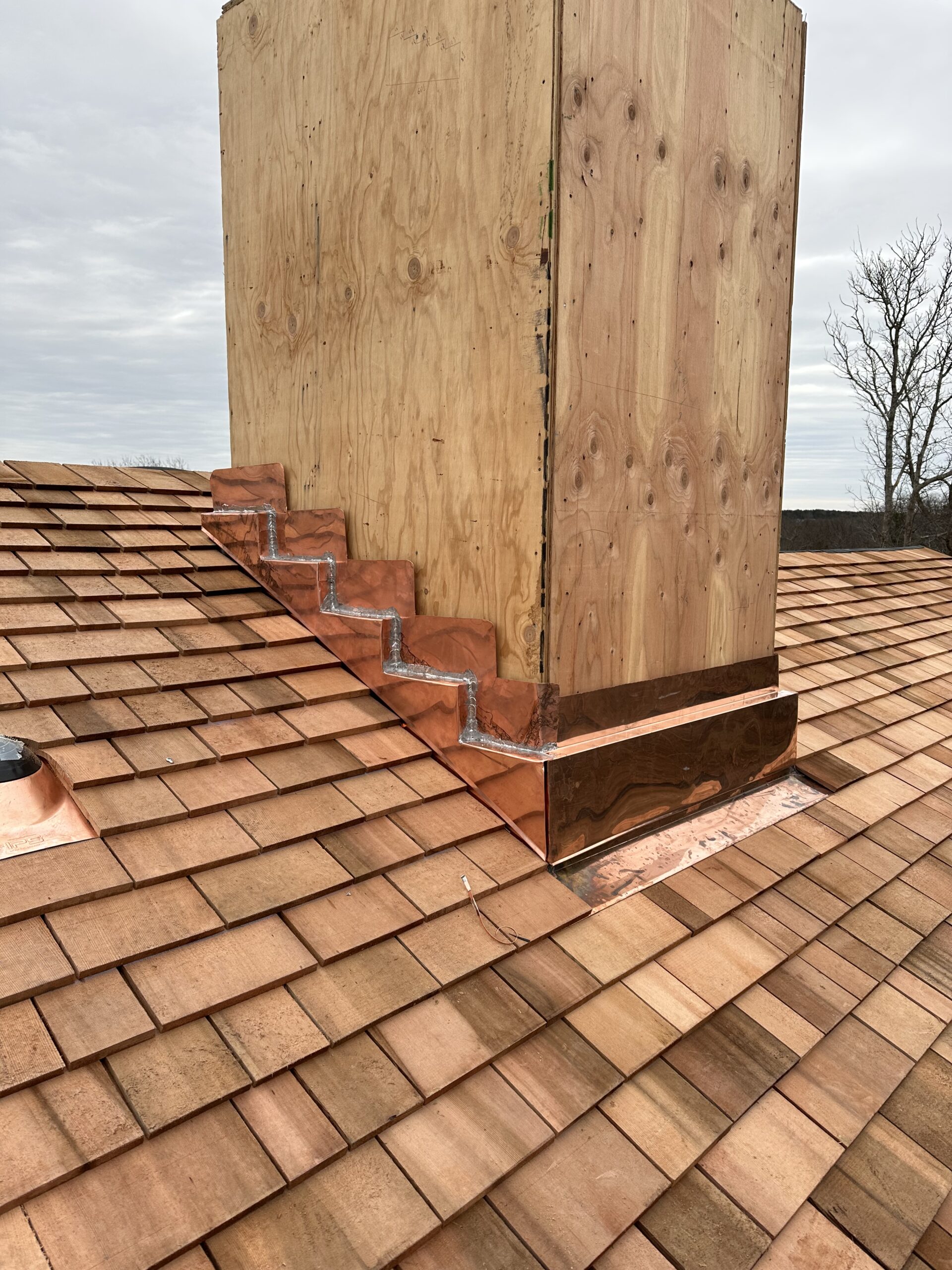
Hand-soldered copper flashings protecting chimney junction - Cape Cod 2026
The Invisible Defense Line: What Flashings Are and Why They Matter
Flashings are metal components that seal the junctions where your roof meets vertical structures: chimneys, vent pipes, walls, and skylights. Their job is to redirect water before it can penetrate beneath your roofing material.
Why Chimneys Present the Greatest Challenge:
- Dual dynamics: Your chimney and roof live in different temperature regimes. The pipe heats up from fireplace use while the roof stays cold. Materials expand and contract at different rates—if flashings are rigidly fixed, seams tear.
- Water vector: Raindrops running down brickwork don't just fall straight down—they move under wind pressure. On Cape Cod, where storms bring driving rain, water can "crawl" under any insufficiently sealed gaps.
- Brick porosity: Masonry absorbs moisture like a sponge. Even with perfect flashings, water can penetrate through brick pores and emerge inside your home—on ceilings or walls.
Field observation: Most leaks we're called to fix originate not from defects in the main roofing material, but precisely at flashing junctions. And often the problem isn't the material itself, but how it was installed.
Why Copper Outperforms Alternatives in Coastal Conditions
The market offers various flashing materials: aluminum, galvanized steel, lead, and composites. But for Cape Cod, copper remains the undisputed leader. Here's why:
Salt Resistance—Without Compromise
Salt air is the primary enemy of most metals. Aluminum oxidizes, galvanized coatings degrade, and steel rusts. Copper behaves differently: under exposure to salt and moisture, it forms patina—a dense protective layer of copper carbonate that seals the surface and stops further corrosion.
Flexibility That Preserves Seams
Copper is malleable. It can be formed around complex architectural elements without losing integrity. This is critical for chimneys with non-standard geometry, historic masonry, or decorative projections. Rigid materials crack under such conditions; copper adapts.
Soldering Instead of Sealant
Many contractors use sealants to flash joints. It's fast, cheap, and... temporary. Sealant dries, cracks, and loses adhesion within 3–5 years. Copper flashings installed to our standards are hand-soldered. Tin solder joints last as long as the copper itself—50+ years.
Aesthetics That Age With Your Home
Copper flashings require no painting. Over time, they shift from golden-brown to distinguished green, harmonizing with Cape Cod's landscape. This isn't just a functional component—it's an architectural detail that adds character to your home.
Anatomy of a Reliable Junction: Principles We Follow
Proper copper flashing installation isn't just about "attaching a metal sheet." It's a system where every element contributes to overall weathertightness. Here are the key principles we build into every project:
Principle of Independent Attachment
Step flashing (side stepped elements) attaches only to the roof, while counter flashing (upper counter-flashing) attaches only to the chimney. This allows both structures to move independently during thermal expansion without creating stress in the seams.
Principle of Dual Barriers
Water must overcome two independent protective layers to penetrate. The lower apron directs flow onto the roof; the upper counter-flashing covers potential gaps. Even under extreme wind loads, the probability of leakage is minimized.
Principle of Continuity
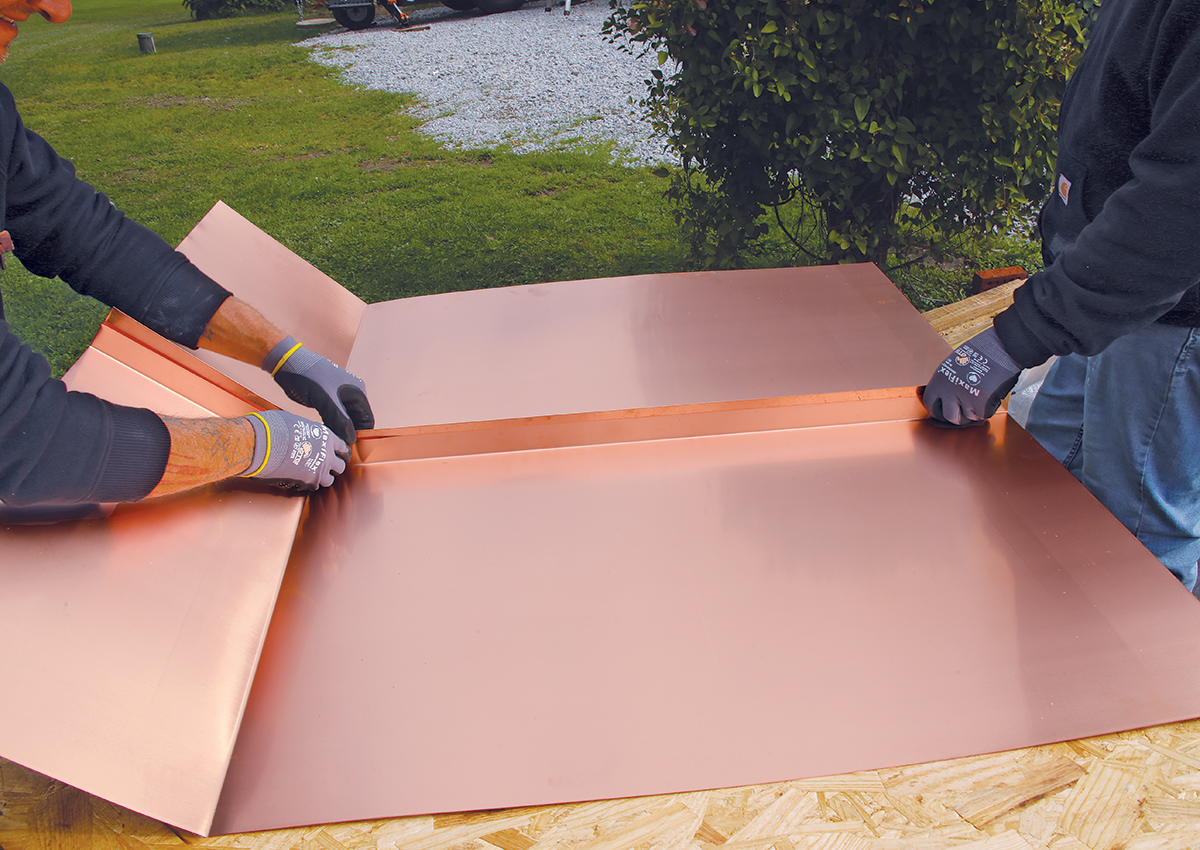
Seams and joints are weak points in any system. We minimize their number and hand-solder every connection. No mechanical clips, no adhesive tapes—only monolithic joints that aren't afraid of vibration and temperature swings.
Principle of Compatibility
Copper shouldn't contact aluminum or galvanized steel directly—this causes galvanic corrosion. We use isolating gaskets and select fasteners from compatible materials so the system works as a unified whole.
How Coastal Climate Affects Flashing Longevity
Cape Cod isn't a typical region. The peninsula's conditions dictate specific requirements for materials and installation:
Salt Air
Accelerates patina formation on copper. This is an advantage: the protective layer forms faster, and the metal reaches stable operating mode sooner.
High Humidity
Requires enhanced masonry waterproofing. We treat chimneys with specialized compounds that reduce brick absorbency without compromising breathability.
Storm-Force Winds
Create pressure on flashings. Our flashings are installed with wind patterns in mind: configuration and bend directions are selected to minimize the risk of water being "blown" under the junction.
Sharp Temperature Swings
Cause materials to expand and contract. Copper is flexible and "breathes" with your home—unlike rigid alternatives that crack under cyclic loading.
If your home sits on the first row from the ocean, we additionally reinforce fasteners and use thicker-gauge copper—this is our standard practice for coastal zones.
Signs Your Flashings Need Attention
Copper flashings don't require frequent maintenance, but there are signals you shouldn't ignore:
Visual Markers:
- Cracks or separations in the flashing junction
- Corrosion spots on metal components (if not copper)
- Deformed shingles around the chimney
- Missing or damaged sealant in masonry joints
Performance Signals:
- Damp spots on ceilings or walls beneath the chimney after rain
- Musty odor in the attic near the flashing junction
- Mold or mildew traces on rafters adjacent to the pipe
Seasonal Manifestations:
- Leaks intensify in fall and spring (thermal expansion periods)
- Problems emerge after storms (wind loading)
- Ice buildup forms around the pipe in winter (condensation indicator)
If you notice even one of these signs—don't postpone diagnosis. Early intervention saves you from costly interior and structural repairs.
Why Professional Installation Matters More Than Material Selection
Even the finest copper won't perform if installed incorrectly. Here's what distinguishes professional execution:
Pre-Installation Assessment
We evaluate the condition of your chimney, roof, and existing junctions. When necessary, we perform masonry repairs or replace damaged deck sections.
Precision Fitting
Each flashing element is custom-fabricated to your chimney's geometry. No universal solutions—only personalized execution.
Quality Control at Every Stage
We verify seam integrity, attachment correctness, and junction compliance with your home's architectural features.
Final Verification
After installation, we conduct weathertightness testing and provide you with documentation recording all completed work.
Visit our copper roofing services page for detailed descriptions of our standards and technologies.
Trust Confirmed Through Results
We don't ask you to take our word for it. Our reputation on Cape Cod is built on tangible outcomes:
- Hundreds of installed junctions without a single weathertightness complaint
- Clients who return to us for other projects after successful experiences
- Recommendations from homeowners across the peninsula, from Bourne to Provincetown
We specialize in copper flashings and junctions throughout the peninsula. Our team knows how to work with historic chimneys, comply with local preservation committee requirements, and create junctions that will survive more than one nor'easter.
Browse our project gallery to see examples of completed work, or contact us directly for a free consultation.
Need a copper flashing specialist on the peninsula? We serve all of Cape Cod—from Bourne to Provincetown. Call today to create invisible protection that will perform for decades.