
What Siding Holds Up Best Near the Ocean? A Coastal Home Guide
When choosing siding for a home near the ocean, it has to deal with more than ordinary rain and seasonal temperature changes. Salt air, humidity, driving rain, strong winds, and repeated wet-and-dry cycles can put additional stress on the exterior.
That raises an important question for coastal homeowners: what siding holds up best near the ocean?
There is no single material that is automatically right for every coastal home. PVC and fiber cement are often practical choices when low maintenance and resistance to moisture are priorities. Cedar can also perform well in coastal conditions when it is properly installed and maintained. Traditional wood siding requires more ongoing attention, particularly in areas with frequent moisture exposure.
But the material itself is only part of the equation. Installation, flashing, drainage, ventilation, maintenance, and the home's specific exposure can have just as much impact on long-term performance.
What Makes Coastal Conditions Hard on Siding?
Siding on a coastal home is exposed to several environmental factors at the same time.
Salt Air
Salt carried through the air can settle on exterior surfaces. Over time, repeated exposure can contribute to weathering and deterioration of exterior finishes and components.
The closer a home is to the water and the more exposed it is to prevailing winds, the more important regular inspection and maintenance become.
Moisture and Humidity
Coastal homes are regularly exposed to moisture from rain, humidity, and wet weather.
The biggest concern is not simply that siding gets wet. Properly designed siding is expected to get wet.
The concern is water that gets where it should not be and remains there.
Poorly detailed joints, failed flashing, inadequate clearances, or water trapped behind siding can create conditions for rot and deterioration.
Driving Rain
Wind can push rain into areas that would normally receive much less water.
Windows, doors, corners, roof-to-wall transitions, and other openings deserve particular attention because these details need to manage water effectively.
Wind
Strong coastal winds can place additional stress on siding, trim, fasteners, and other exterior components.
Proper fastening and installation become particularly important on exposed properties.
Temperature Changes
Seasonal expansion and contraction can affect siding and finishes over time.
A quality installation needs to account for the material's characteristics rather than treating all siding products in exactly the same way.
Which Siding Materials Perform Best Near the Ocean?
The most common options to consider are PVC, fiber cement, cedar, and wood.
Each has a different balance of durability, maintenance, appearance, and cost.
| Material | Coastal Performance | Maintenance | Typical Lifespan | Best For |
|---|---|---|---|---|
| PVC | Very good | Low | 30–50+ years | Low-maintenance coastal homes |
| Fiber cement | Very good | Low to medium | 30–50 years | Durability and wood-style appearance |
| Cedar | Very good with maintenance | Medium to high | 20–40+ years | Traditional coastal architecture |
| Wood | Good with regular maintenance | High | 15–30 years | Historic and traditional homes |
These lifespan ranges are general. Actual performance depends on installation, exposure, maintenance, moisture management, and the condition of the wall assembly.
PVC Siding for Coastal Homes
PVC is often attractive to coastal homeowners because it requires relatively little routine maintenance and is resistant to moisture and rot.
That can be useful for properties where the exterior is regularly exposed to humidity, rain, and coastal weather.
PVC also comes in a range of profiles and colors, making it possible to create a traditional exterior without using natural wood.
However, choosing PVC does not eliminate the need for proper installation.
Water still needs to be managed around:
- Windows
- Doors
- Corners
- Rooflines
- Wall penetrations
- Trim
- Transitions between materials
PVC may be a good fit when the homeowner wants a practical exterior with less ongoing maintenance.
See our PVC siding installation options for more information.
Fiber Cement Siding Near the Ocean
Fiber cement is another strong option for coastal properties.
Its main advantages are durability, relatively low maintenance, and the ability to achieve the appearance of traditional painted wood siding.
For homeowners who like the look of wood but do not want the same level of routine maintenance, fiber cement can provide a useful middle ground.
It is particularly suitable for homes where durability and appearance both matter.
But again, the material cannot compensate for poor detailing.
Proper installation should address moisture management, flashing, joints, clearances, and other areas where water can enter the exterior assembly.
See our fiber cement siding options for material and installation details.
Is Cedar Good for a Coastal Home?
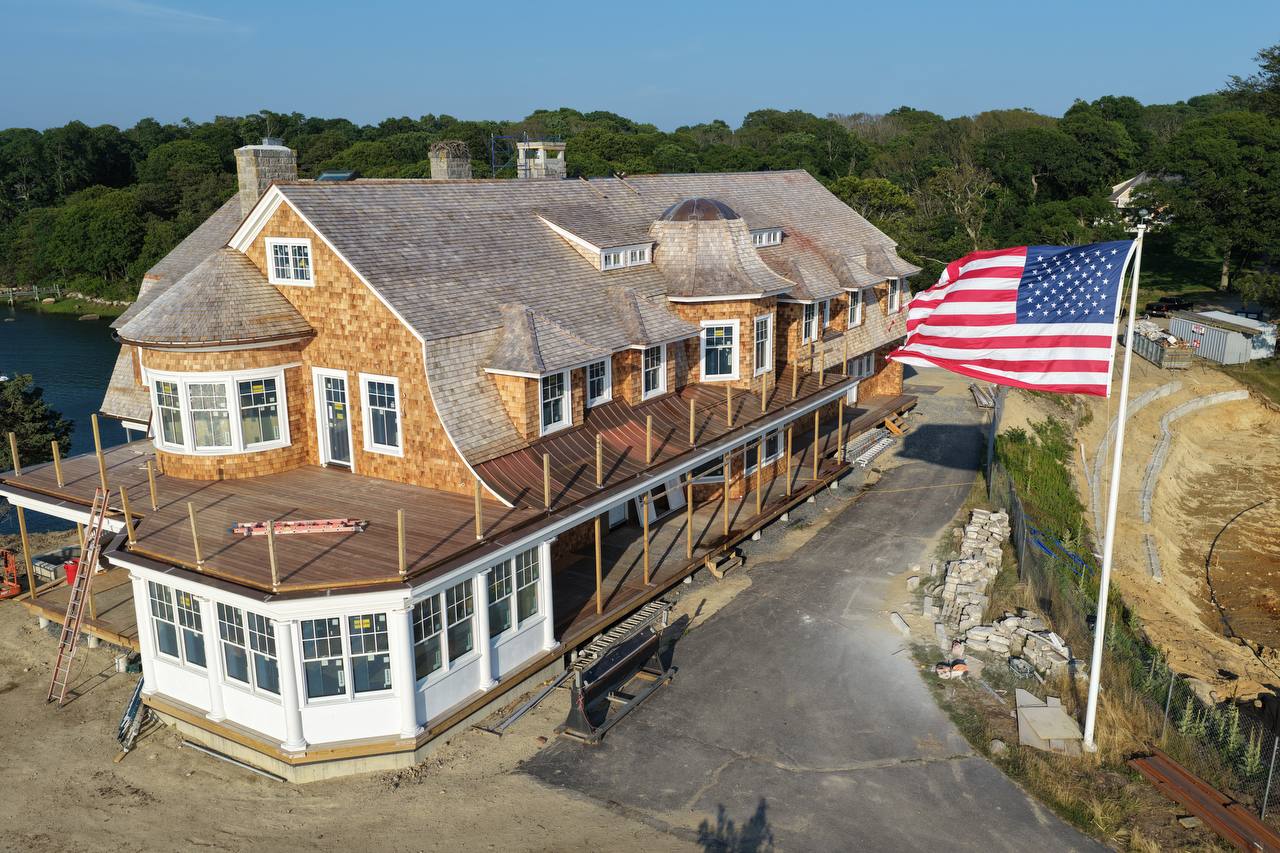
Yes. Cedar can be an excellent choice for a coastal home, particularly when the architectural style calls for natural wood.
Cedar is common in traditional New England and Cape Cod architecture because of its natural texture and distinctive appearance.
It can create a warmer and more authentic exterior than manufactured alternatives.
The tradeoff is maintenance.
Cedar needs appropriate protection from moisture and weather exposure. Depending on the finish and location, homeowners may need to clean, stain, paint, and inspect the siding periodically.
On a home exposed to strong coastal weather, maintenance should not be treated as optional.
A well-maintained cedar exterior can last for decades, but neglected wood is much more vulnerable to moisture-related deterioration.
Learn more about our cedar siding options.
What About Traditional Wood Siding?
Traditional wood siding can still be the right choice for certain coastal homes.
It is particularly relevant when preserving the character of an older or historic property is more important than minimizing maintenance.
Wood provides natural texture and can complement traditional New England architecture exceptionally well.
The disadvantage is that it generally requires more attention than PVC or fiber cement.
Homeowners should regularly inspect wood siding for:
- Peeling or failing paint
- Cracks and splits
- Soft areas
- Rot
- Moisture staining
- Open joints
- Damaged boards
If these problems are addressed early, individual sections may sometimes be repaired rather than replaced.
See our wood siding options for more information.
Cedar vs. Fiber Cement Near the Ocean
For many coastal homeowners, the most difficult decision is between cedar and fiber cement.
Both can provide an attractive exterior, but they approach maintenance differently.
| Factor | Cedar | Fiber Cement |
|---|---|---|
| Natural appearance | Excellent | Very good |
| Maintenance | Higher | Lower |
| Typical lifespan | 20–40+ years | 30–50 years |
| Moisture management | Requires regular maintenance | Strong performance when properly installed |
| Traditional architecture | Excellent | Very good |
| Maintenance priority | More important | Less demanding |
| Coastal use | Very good | Very good |
Cedar is usually the better fit when natural wood character is the priority. Fiber cement is often the better fit when durability and lower maintenance are more important.
There is no reason to choose one simply because it is considered a "coastal" material. The property itself should determine the decision.
For a more detailed comparison, read our guide on cedar vs. fiber cement siding.
Does Being Closer to the Ocean Change the Choice?
It can.
A home several miles inland may experience very different conditions from a house directly exposed to ocean winds.
Consider:
- Distance from the water
- Direction of prevailing winds
- Exposure of each side of the house
- Vegetation and surrounding buildings
- Roof overhangs
- Existing moisture problems
- Orientation of windows and doors
- Local drainage conditions
Two houses in the same coastal town may therefore need different siding solutions.
A property directly facing strong coastal exposure may place greater emphasis on moisture management, fastening, maintenance, and material durability.
Installation Matters as Much as Material
One of the easiest mistakes is to spend considerable time choosing siding while treating installation as an afterthought.
The siding is part of a larger exterior system.
Water needs to be directed away from the wall rather than allowed to penetrate behind the siding.
Important details include:
- Flashing around windows and doors
- Proper installation of trim
- Correct clearances
- Appropriate fastening
- Proper treatment of joints
- Drainage and moisture management
- Transitions between different exterior materials
This is especially important when replacing older siding.
Removing the existing material can reveal deteriorated sheathing, damaged areas, or previous installation problems that need to be addressed before new siding goes on.
Should You Replace Coastal Siding Before It Fails?
Not necessarily.
Siding does not need to be replaced simply because it has reached a certain age.
Instead, look at its actual condition.
Replacement becomes more worth considering when you see several problems at once:
- Widespread rot
- Repeated moisture damage
- Warped or buckled sections
- Extensive cracking
- Frequent repairs
- Persistent paint failure
- Siding pulling away from the wall
- Deterioration around windows and doors
If damage is limited to a small area and the surrounding siding is healthy, repair may still be the better option.
Our guide on when you should replace your siding covers the warning signs in more detail.
How Should Coastal Siding Be Maintained?
Even low-maintenance siding benefits from regular inspection.
A simple inspection once or twice a year can help identify small problems before they become larger ones.
Look particularly closely after periods of severe weather.
Check:
- Lower sections of the walls
- Areas around windows and doors
- Corners and joints
- Roof-to-wall transitions
- Trim and flashing
- Areas exposed to prevailing winds
- Previous repair locations
- Paint and finish condition
For natural wood, maintenance is even more important.
For PVC and fiber cement, the focus is more on cleaning, inspection, damaged sections, joints, and moisture management.
The objective is not to make the exterior maintenance-free. It is to catch problems while they are still manageable.
What Is the Best Siding for a Cape Cod Coastal Home?
There is no universal winner.
PVC is a practical choice for homeowners who want low maintenance and good moisture resistance. Fiber cement is a strong option when durability, lower maintenance, and a wood-style appearance are priorities. Cedar is an excellent choice when natural beauty and traditional Cape Cod character matter most. Wood siding remains appropriate for historic and traditional homes where authenticity is important, but it requires more maintenance.
For homes in Cape Cod and the South Shore, the final decision should consider more than the material's advertised lifespan.
Think about the home's architecture, exposure to the ocean, moisture conditions, maintenance expectations, and the condition of the existing exterior.
The best siding is ultimately the one that fits the home, suits its exposure, and can be properly installed and maintained over time.
If you're planning an upgrade, you can explore our siding installation and replacement services and choose a material based on the actual needs of your home.